Driver's License Practice Test
Rall SoftwaresEducation
4.7637.00 Reviews
- Version
- 1.6.1
- Installs
- 100.00K
- Age Rating
- Everyone
Screenshots
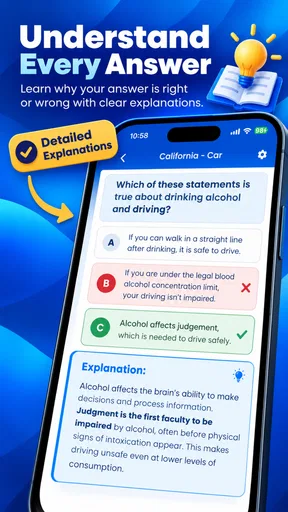
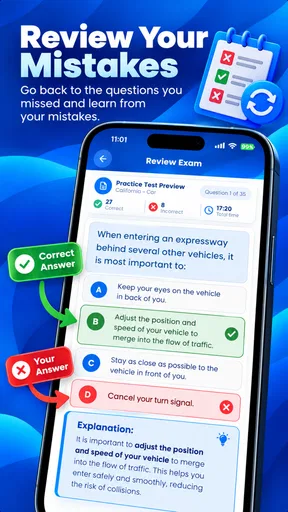
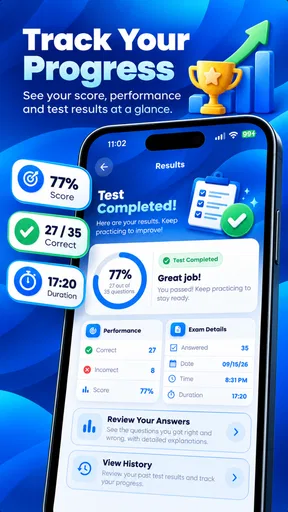
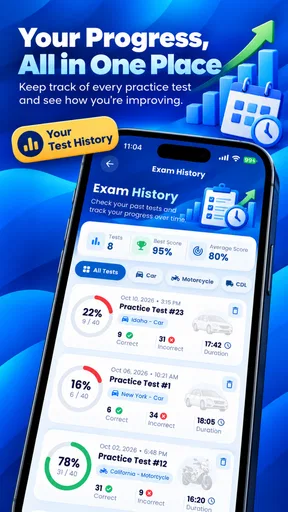
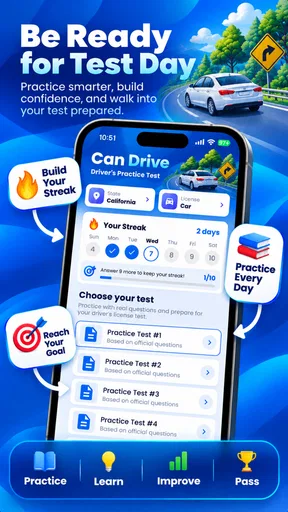
Our Review of Driver's License Practice Test
 Analysis by Appyee
Preparing for a driving test is rarely difficult because people lack access to information. The harder part is turning scattered rules into quick, reliable decisions under pressure. Driver's License Practice Test, an education app from Rall Softwares, aims to make that preparation more manageable by putting practice questions into a format I can return to whenever I have a spare moment. After using it, I see its main value less as a complete driving course and more as a repeatable revision companion.
The app is free to start, carries an Everyone age rating, and is designed for people who want to build confidence before a theory exam. Its store summary promises preparation for passing with confidence, but I would frame the experience more carefully: it can help you recognize common question patterns and expose weak areas, yet it should not replace learning the official rules or gaining real experience behind the wheel. That distinction matters if you are deciding whether it deserves a permanent place on your phone.
How the app feels from the first week to regular use
I find the first week most useful when I treat each session as a small check-in rather than a measure of whether I’m ready to drive. Once the routine settles, the bigger question is whether the app’s presentation works comfortably for the way I read, navigate, and concentrate.
A simple first-week routine
During the first week, the strongest appeal is convenience. I can open the app, answer a short run of questions, and close it without having to organize notes, search through a long manual, or commit to a full study session. That makes it particularly useful for the small gaps that normally disappear during a busy day: waiting for an appointment, sitting on public transport, or taking a few minutes before bed.
The interface is built around the familiar practice-test idea, so there is little learning curve. I do not need to understand a complicated course structure before getting started. The useful habit is to treat each session as a diagnostic rather than as a race. When I answer quickly and get something wrong, the mistake tells me where my understanding is weak. Simply tapping through questions until I see a high result can feel productive while leaving the underlying rule unclear.
For a learner who has never encountered driving-theory material, the app works best as an introduction to the shape of the exam rather than as the only teaching tool. Practice questions show the type of decisions that need to become automatic, but a question-and-answer format cannot always explain the wider context of a road rule. I would begin with the relevant official handbook, then use this app to test whether I can recall the material without looking.
That order also prevents a common mistake: memorizing the appearance of an answer instead of understanding why it is correct. If I miss a question, I make a short note in my own words before moving on. This extra step takes longer, but it turns the app from a guessing exercise into a revision tool. It is one of the clearest ways to get more value from a lightweight practice app.
Who benefits most at the beginning
The best early users are people who already have access to proper learning material and need repetition. Someone preparing for a first theory test may appreciate the low barrier to entry, while a learner returning after a failed attempt can use repeated quizzes to identify topics that still cause hesitation. It is also handy for a person who dislikes studying from a long block of text and needs frequent prompts to stay engaged.
I would be more cautious about recommending it to someone who expects a complete driving-school replacement. Passing theory questions is not the same as judging distance, reading traffic, controlling a vehicle, or responding safely to an unexpected situation. The app belongs on the revision side of preparation. A qualified instructor and official local guidance remain more important for practical driving and for rules that vary by location.
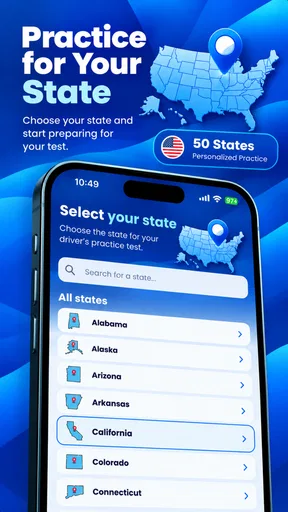
There is another practical question: will it work for every learner’s jurisdiction? The app is called Driver's License Practice Test, but a driving test is not identical everywhere. Before relying on any question set, I would compare its wording and topics with the handbook used by the local licensing authority. If your exam uses region-specific signs, penalties, procedures, or terminology that the app does not reflect, an official source is the better reference.
What changes after the novelty fades
In the first few sessions, the quiz format itself provides motivation. Each question feels like a small challenge, and visible improvement can encourage another round. That initial momentum is useful, but it is not the same as lasting value. The important test is whether the app still helps once the questions feel familiar and the excitement of a new download has disappeared.
For me, the answer depends on using it in cycles. I would not leave it open all day or repeat the same kind of session without a purpose. Instead, I would alternate between reading, answering, reviewing mistakes, and returning later to check whether the correction stayed in memory. This turns a free app into a structured routine without requiring a complicated study plan.
A realistic example is a learner with a theory exam approaching who studies the official material on a weekend, uses the app for short recall sessions during the week, and reserves one longer session to revisit errors. In that routine, the app does not need to teach everything. Its job is to reveal what the learner forgets between study sessions. That recurring function is more valuable than treating every quiz result as a final judgement of readiness.
Keeping practice useful from month to month
Longer-term usefulness comes from maintaining a record of uncertainty. I recommend separating mistakes into three groups: rules I genuinely do not understand, answers I knew but rushed, and questions where the wording confused me. Each group needs a different response. The first calls for reading the source material, the second calls for slower practice, and the third calls for paying attention to exact wording rather than relying on visual familiarity.
This method also helps prevent false confidence. If I keep getting a familiar question right because I remember its layout, that result may not prove that I can solve a differently worded version. I try to explain the rule aloud before selecting an answer. When I cannot explain it, I mark it as unfinished even if the app records a correct response.
The app’s free availability makes this kind of repeated use easy to maintain financially. There are in-app purchases ranging from $1.90 to $19.99 per item, so I would check what an optional purchase changes before paying. The free starting point is enough to evaluate whether the question style suits me. I would not buy anything simply because I had a poor practice result; a weak result may indicate that I need better source material, not more app content.
That is an important trade-off for long-term use. A paid upgrade can be worthwhile if it gives access to material that matches the learner’s needs, but the app should not become a substitute for official information. I would first compare the available practice with the local exam outline and only then decide whether additional content has a clear purpose.
Maintenance: the effort required to keep it effective
The maintenance burden is fairly low because the app is designed for repeated practice rather than elaborate planning. The real work is not technical; it is intellectual. I have to resist rushing through familiar questions, revisit errors, and keep the app connected to authoritative learning material. Without that discipline, practice can become a repetitive tapping habit.
Version 1.6.1 is the current version, and the app supports devices running Android 7.0 or later. That broad compatibility should make it accessible to people using an older Android phone, although device performance and screen comfort can still affect the experience. A small screen may make detailed sign questions or longer wording harder to inspect carefully, so I would use a larger display when I need to study slowly rather than squeeze in a quick session.
Because this is an Android app, it is not the natural choice for someone who studies primarily on an iPhone or iPad. That may sound obvious, but it affects habit formation. A study tool is most useful when it is available where the learner already spends spare time. If your main device is outside the supported platform, a comparable option on that platform may be more practical even if this app’s approach looks appealing.
I also recommend keeping a separate note of rules that need confirmation. Practice apps are convenient, but the licensing authority’s handbook should settle any conflict in wording or interpretation. This is especially important when a learner moves, studies in a different region, or prepares for an exam with local requirements. The app can support recall, but it should not be treated as the final authority on every detail.
Where fatigue starts to appear
The same question-based design that makes the app approachable can eventually become tiring. Repetition is useful for memory, but repeated exposure to similar prompts can encourage shallow recognition. I notice this kind of fatigue when I start answering from the position of an option on the screen rather than from the rule itself. At that point, another quiz is not necessarily another productive study session.
My solution is to change the task instead of simply increasing the number of questions. I pause after an error, describe the situation in plain language, and connect it to a real driving decision. I may also stop after a short session while I am still focused. Ending before concentration collapses is better than turning practice into a frustrating endurance test.
There is also emotional fatigue. A low score can be useful feedback, but seeing several mistakes in a row may make a learner feel unprepared without showing exactly how to improve. The app works better when results are treated as signals. I would compare today’s mistakes with last week’s notes and look for recurring topics, rather than judging my ability from one session.
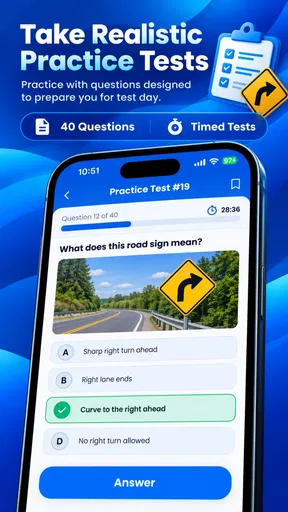
Another limitation is that practice questions cannot reproduce every pressure of a real test. They may help with recall, but they do not fully recreate time anxiety, unfamiliar wording, or the responsibility of interpreting a complete traffic situation. For that reason, I would combine app sessions with timed practice from official or trusted study material, especially near the exam. The app is a useful part of preparation, not a complete simulation of every challenge.
How it compares with the usual alternatives
The most obvious alternative is a printed handbook. The handbook is slower to browse, but it provides context, definitions, diagrams, and the official wording that a quiz alone may not offer. I prefer the handbook for learning a rule for the first time and the app for checking whether I can remember it later. Choosing only one means giving up either convenience or depth.
Video lessons offer another contrast. They can explain a situation visually and may be easier for learners who struggle with dense text. However, watching a video can create a sense of understanding without requiring active recall. The practice-test format makes me commit to an answer, which exposes uncertainty more honestly. I would use video for explanation and this app for retrieval practice rather than expecting either format to do both jobs perfectly.
In-person instruction remains stronger for questions about local procedures and for connecting theory with real driving behavior. An instructor can notice confusion, adapt an explanation, and relate a rule to an actual road environment. The app is more flexible and private, but it cannot provide that personal correction. Learners who need accountability may therefore get more from scheduled lessons or a teacher-led course, using the app only between sessions.
Other quiz apps may offer broader customization, progress tracking, or more polished presentation. I would choose this one when I want a straightforward, low-cost way to practise on an Android device and do not need a large study system. I would choose another option when regional accuracy, detailed explanations, accessibility features, or a specific exam simulation are the deciding factors. The right choice depends less on the highest score in a store and more on whether the content matches the exam I will actually take.
Who should keep it installed
The app earns lasting space for learners who can give it a defined role. Keep it installed if you want short recall sessions, benefit from answering questions instead of rereading, and are willing to verify important rules against official material. It is especially suitable for building a modest daily habit because opening it requires less effort than arranging a full study block.
It is less suitable for someone who wants step-by-step teaching from the beginning, needs an instructor’s feedback, or is preparing for a highly local exam without checking the question coverage. It may also disappoint learners who expect practice scores alone to guarantee readiness. A high result is encouraging, but it should be supported by the ability to explain the rules and apply them in realistic situations.
Rall Softwares has positioned this as an education app rather than a driving simulator, and that distinction matches my experience. It is about mental rehearsal: reading a situation, choosing an answer, noticing a mistake, and repeating the process until the decision becomes more dependable. That is a narrower purpose than “learn to drive,” but it is a useful one when used honestly.
My long-term verdict
Driver's License Practice Test has a strong first-week appeal because it makes theory revision easy to start and easy to repeat. Its 4.7 average from around 8.1 thousand ratings and more than 100 thousand installs suggest that many learners find the format useful, although popularity does not remove the need to check local relevance for your own exam. The app is free, with optional in-app purchases, so trying its basic approach carries little financial risk.
After the novelty fades, I would keep it as a supporting tool rather than my only study resource. Its lasting value comes from a routine built around mistakes, not from endlessly chasing better quiz results. Use official material to understand the rules, use the app to test recall, and stop when repetition becomes automatic guessing. That workflow gives the app a clear job and keeps its limitations visible.
My recommendation is simple: keep it if it turns spare minutes into focused revision, but do not let a practice score replace real understanding. For a learner who wants a convenient Android companion before a theory test, it is a sensible download. For someone seeking complete instruction, local authority guidance, or practical driving feedback, a handbook, instructor, or more specialized course will be the better long-term investment.
Verdict
Strengths of Driver's License Practice Test
- Covers road signs, rules, and traffic situations in one app.
- Short quizzes make it easy to practice during spare moments.
- Immediate answers help identify mistakes quickly.
- Useful for refreshing knowledge before taking a written exam.
- Simple interface is suitable for first-time learners.
Limitations of Driver's License Practice Test
- Questions may vary depending on the selected state or region.
- Some explanations may be too brief for complete beginners.
- Practice tests cannot replace supervised driving lessons.
- Repeated quizzes can become predictable after frequent use.
- Certain features may require an internet connection or paid access.
Similar Picks in This Category
View All
Duolingo: Language Lessons
Duolingo4.7

Google Classroom
Google LLC2.8

Unacademy: Learn & Crack Exams
Unacademy3.2

Bible App for Kids
Life.Church4.4

Cake - Learn English & Korean
Cake Corp.4.7

Brainly: AI Homework Helper
Brainly4.5
Frequently Asked Questions
What is Driver's License Practice Test, and who is it for?
Driver's License Practice Test is a study app designed to help learners prepare for written driving theory exams. It is useful for first-time applicants, people renewing their knowledge, and drivers who want extra practice before taking an official test. The app typically presents questions about road signs, traffic laws, safe driving, and common driving situations in a quiz-style format.
Does the app include questions for my state or country?
Coverage can vary depending on the version of Driver's License Practice Test and the region selected in the app. Before relying on it, check whether your state, province, or country is supported and compare the topics with the official driver handbook. Traffic rules and exam questions differ between jurisdictions, so regional accuracy is important when using the app as a primary study resource.
Can I use Driver's License Practice Test without an internet connection?
Many practice-test apps allow at least some quizzes to be used offline after installation, but this depends on the app version and the specific content package. Features such as advertisements, progress synchronization, updates, or additional question sets may require an internet connection. It is a good idea to open the app before studying offline and confirm that the desired tests load correctly.
Does the app show explanations for incorrect answers?
Driver's License Practice Test is most helpful when it does more than mark an answer as right or wrong. Practice sessions may include explanations, correct-answer details, road-sign descriptions, or references to driving rules. These explanations help identify weak areas instead of encouraging memorization alone. However, users should still consult the official handbook whenever an explanation seems unclear or differs from local regulations.
Is passing the app's practice tests enough to pass the official exam?
No practice app can guarantee a passing result. Driver's License Practice Test can improve familiarity with common questions, signs, and traffic concepts, but the official examination may use different wording or cover additional material. For the best preparation, combine repeated practice with a careful reading of your local driver handbook, review every mistake, and avoid taking the official test until you understand the underlying rules.
